

Portfolios and reviews tell you whether a Joomla developer finishes projects. They don't tell you whether the site will still be easy to update in three years. That depends on how the developer builds: overrides or core edits, child template or edited vendor template, a plugin or a hack in index.php.
These are the questions we'd ask if we were hiring a Joomla developer ourselves, with the answers that show real experience. You don't need to be technical to use them. Listen for specifics.
1. "How will you change how an article or module looks?"
Good answer: with a template override in templates/<template>/html/, made through System → Templates, ideally in a child template, so a template update can't overwrite it. They should mention that Joomla flags overrides when the core layout changes in an update.
Red flag: "I'll edit the file in components/com_content/". The next Joomla update wipes that change, or it blocks updates altogether.
2. "What would you do if an extension doesn't do exactly what we need?"
Good answer: it depends on the extension. First check its settings and its own extension points. Then a template override for its output, or a small plugin that listens to its events. Editing the vendor's code only as a last resort, in a documented patch that is re-applied on update.
A developer who reaches for a plugin knows that Joomla is event-driven. That is the single best sign of real Joomla experience, as opposed to general PHP experience.
3. "Which Joomla and PHP versions will the site run on, and why?"
Good answer, in 2026: Joomla 6.x on PHP 8.3 or 8.4 for a new site. Joomla 5.4 only if a required extension isn't ready for 6, with a plan to move before 5.4's support ends in October 2027. They should know that Joomla 6 needs PHP 8.3 and that old J* class names are off by default.
Red flag: not knowing the current version, or proposing Joomla 4 because "the template is for 4".
4. "How do you deploy changes to the live site?"
Good answer: code in Git; changes made and tested on a staging copy; deployed to live in a controlled way; a backup before every deploy. They can explain how database changes (new menu items, module settings) get to live, which is the hard part with Joomla, because much of a site's configuration lives in the database.
Red flag: "I work directly on the live site, it's faster."
5. "How do you keep the site secure after launch?"
Listen for specifics, not "we use a security extension":
- updates on a schedule, with security releases applied the same week;
- MFA enforced for administrators (Joomla has it in core since 4.2);
- off-site backups that are restored as a test now and then;
- no PHP execution in upload folders, and the admin area protected at the server level;
- a clean list of who has Super User access.
Our full list is in Joomla security against automated attacks.
6. "Show me code you wrote for Joomla."
Ask for a module, plugin or component from a recent project, or a public repository. Even without reading PHP, you can check a few things:
- a
src/folder with namespaced classes and aservices/provider.php: current Joomla structure since Joomla 4; use Joomla\CMS\…at the top of files, notJFactory::orJText::, which no longer load by default on Joomla 6;- language strings in
.inifiles, not English text in the PHP; - an update server in the manifest, so the extension can be updated from the back end.
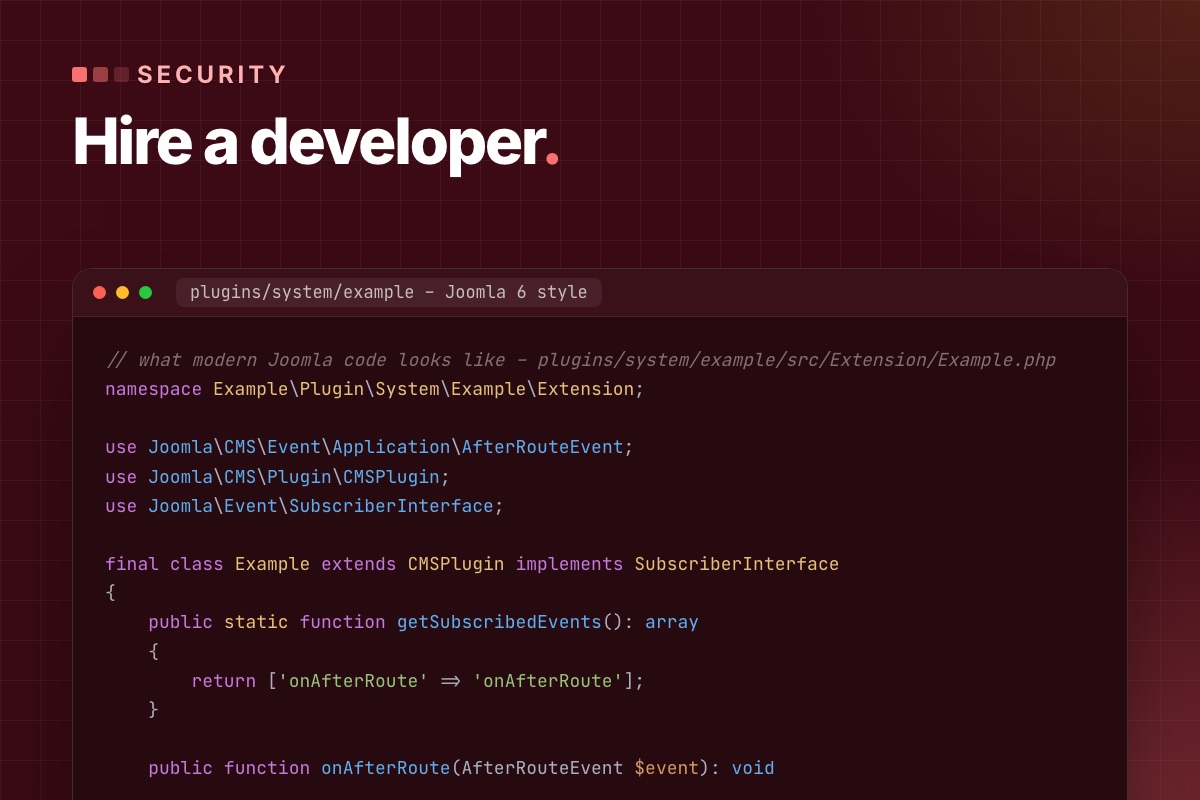
// what modern Joomla code looks like – plugins/system/example/src/Extension/Example.php
namespace Example\Plugin\System\Example\Extension;

use Joomla\CMS\Event\Application\AfterRouteEvent;
use Joomla\CMS\Plugin\CMSPlugin;
use Joomla\Event\SubscriberInterface;

final class Example extends CMSPlugin implements SubscriberInterface
{
    public static function getSubscribedEvents(): array
    {
        return ['onAfterRoute' => 'onAfterRoute'];
    }

    public function onAfterRoute(AfterRouteEvent $event): void
    {
        // …
    }
}
7. "How do you estimate an upgrade or a takeover?"
Good answer: they look before they quote. A short paid audit, or at least a look at the extension list, the template and the overrides, and a check for modified core files, then a fixed quote with clear assumptions. Anyone who gives a fixed price for a Joomla 3 → 6 migration without seeing the site is guessing, and you'll pay for the guess one way or another. We describe our own takeover audit in taking over a Joomla site.
8. "What happens to the site if we stop working together?"
Good answer: you own everything: the code (in a repository you can access), the hosting and domain accounts, the extension licences, and a short document on how the site is built. No custom extension you can't update without them.
Freelancer, agency or in-house?
| Works well for | Watch out for | |
|---|---|---|
| Freelancer | small sites, clear scope, a direct line to the person who builds | holidays and illness; ask who covers urgent fixes |
| Joomla-focused team | upgrades, custom extensions, shops, long-term maintenance | make sure you know who actually does the work |
| General web agency | projects where Joomla is a small part | Joomla may be one CMS among many, so ask questions 1–3 above |
| In-house | constant changes, many internal integrations | knowledge leaves with the person; insist on Git and documentation |