

The PHP November 2026 security release shipped on 19 November: PHP 8.5.13, 8.4.28, 8.3.37 and 8.2.36. Together they fix 17 security advisories, seven of them rated Critical. None of the Critical ones works against every PHP site. Each needs a specific combination of server settings and application behavior: persistent FastCGI connections, file-based sessions holding visitor-supplied data, a PHP startup warning written to a log file. A Joomla 6.2 site with database sessions behind nginx or Apache defaults does not match the attacks demonstrated so far. That is not the same as not vulnerable, and it depends on your server settings, your Joomla session handler and your extensions. Update PHP this week, and use the four checks below to see how exposed your server is until then.
What PHP released on 19 November
| Branch | Fixed release | Security advisories | Support |
|---|---|---|---|
| PHP 8.5 | 8.5.13 | 17 (7 Critical) | Active |
| PHP 8.4 | 8.4.28 | 14 (5 Critical) | Active until 31 Dec 2026, then security fixes only |
| PHP 8.3 | 8.3.37 | 13 (5 Critical) | Security fixes only, until 31 Dec 2027 |
| PHP 8.2 | 8.2.36 | 12 (4 Critical) | Security fixes only, ends 31 Dec 2026 |
| PHP 8.1 and older | None from the PHP project | – | End of life |
PHP announced the release a day ahead and said the Critical issues "require either non-default configuration or uncommon setups". The advisories published with the release list the conditions each issue needs and what has been demonstrated so far. Sources: the PHP 8 changelog and the php-src security advisories.
The Critical issues, and what each one needs
Four Critical issues affect every supported branch, a fifth affects 8.3 and later, and two more exist only in PHP 8.5. All have a CVSS 4.0 score of 9.2.
| Issue | What it needs |
|---|---|
| PHP-FPM request smuggling CVE-2026-129289 | A web server that keeps FastCGI connections open (nginx fastcgi_keep_conn on, Apache enablereuse=on, HAProxy, or LiteSpeed's LSAPI) and code that opens php://input without reading it to the end. No special PHP setting is needed. PHP says standard nginx and Apache setups that close the connection after each request are not affected by the demonstrated attack; for LSAPI, code execution has not been shown. |
| Partially overwritten session files CVE-2026-126714 | PHP's files session handler (PHP's default), attacker influence over what is stored in the session, a write interrupted at the right point, and a usable object chain in the application. |
| Session serializer mismatch CVE-2026-115560 | Session upload progress enabled, and two serializers reading and writing the same session store: either code that switches session.serialize_handler at runtime, or two applications with different settings sharing one session directory. |
| Timezone cache use-after-free CVE-2026-129496 | A warning or deprecation during PHP startup (confirmed examples: an invalid date.timezone, a deprecated session setting) that is written to a PHP error_log file. PHP-FPM's own log does not meet the condition by itself. |
| Interrupted session shutdown CVE-2026-129481 · PHP 8.3+ | A fatal error in a callback that runs while the session is being cleaned up. Demonstrated with OPcache off; code execution has not been demonstrated. Turning upload progress off does not help here. |
| Backtrace use-after-free CVE-2026-129474 · PHP 8.5 only | Fatal error backtraces that include arguments. That is PHP's built-in default; only a php.ini based on php.ini-production (zend.exception_ignore_args=1) turns it off. |
| Backtrace reuse after shutdown CVE-2026-129182 · PHP 8.5 only | max_memory_limit or zlib output settings overridden per directory, plus a later early diagnostic. Code execution has not been demonstrated. Until 8.5.13 is installed, fatal_error_backtraces=0 blocks both PHP 8.5 issues. |
The other ten are rated High or Medium: a PHP-FPM local privilege escalation, a PHAR signature bypass, plaintext exposure with mixed-case HTTPS:// and FTPS:// URLs, a denial of service through folded HTTP headers, and issues in SOAP, DOM, PHP-CGI, the FPM status page and the new URI class.
Is a Joomla site affected?
Joomla core does not create these conditions by itself, but two Joomla settings and your extensions matter. What we checked in the Joomla 6.2 code:
- Request body. Core reads the raw body through its JSON input classes (
Joomla\Input\Jsonand the legacy copy in the compat plugin), and both read it to the end. Core also ships PSR-7 libraries (laminas-diactoros, guzzle/psr7) that openphp://inputwithout reading it when an extension uses them, so the connection setting in Check 1 is what counts. - Sessions. With the session handler set to Database, Joomla's own sessions never go through PHP's
fileshandler. PHP itself still writes session files for upload progress if that is enabled, so turn it off (Check 2). With Filesystem, the session file issue applies: Joomla keeps submitted form data in the session, and turning upload progress off does not change that. Switch to Database or update PHP. - Serializer. Core accepts
serialize_handleras a session option but never passes it, so Joomla runs with whatever php.ini says and does not switch it at runtime.
// libraries/vendor/joomla/input/src/Json.php – where core reads the request body
$this->raw = file_get_contents('php://input');
Check 1: does the web server keep FastCGI connections open?
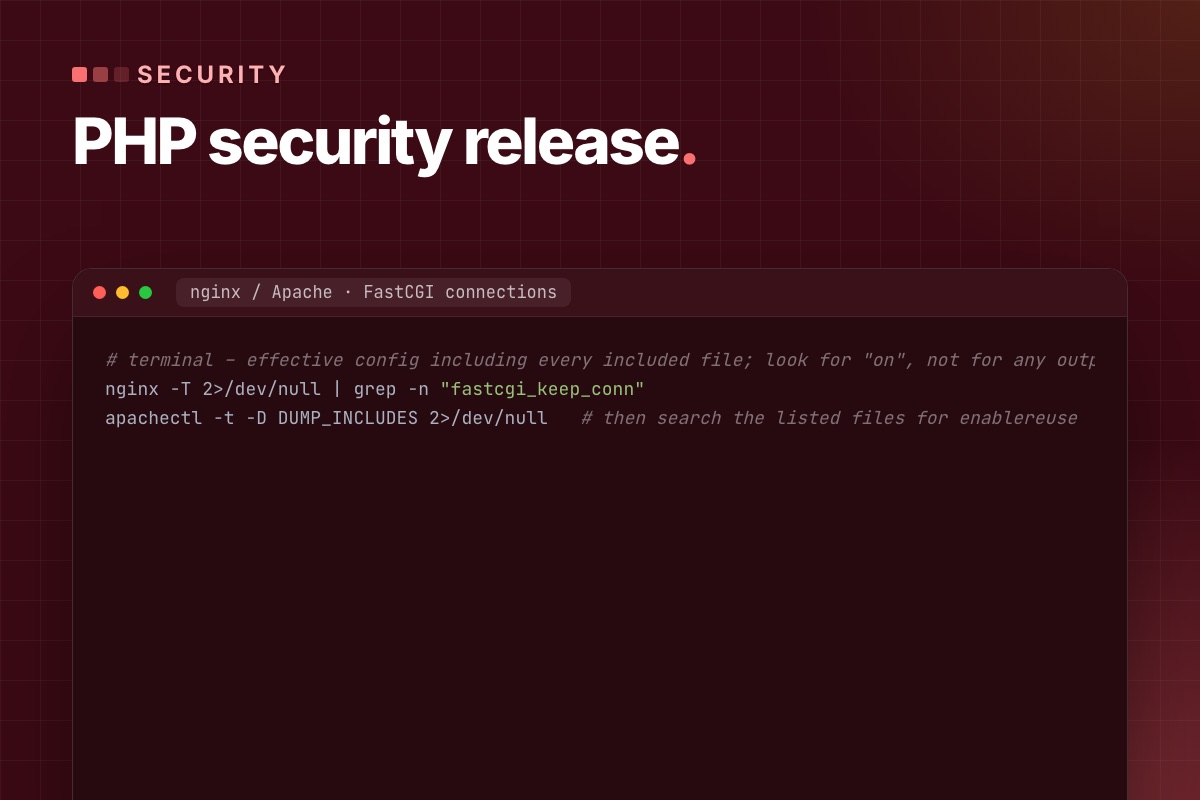
# terminal – effective config including every included file; look for "on", not for any output
nginx -T 2>/dev/null | grep -n "fastcgi_keep_conn"
apachectl -t -D DUMP_INCLUDES 2>/dev/null   # then search the listed files for enablereuse
If either is on, turn it off until PHP is updated; that is the mitigation PHP gives. HAProxy or another FastCGI front end: check its own configuration for backend connection reuse. On LiteSpeed and on shared hosting you cannot see this yourself, so ask the host. PHP-FPM should never listen on a port that untrusted networks can reach.
Check 2: where do sessions live, and is upload progress on?
In the Joomla administrator open System → Global Configuration → System and look at Session Handler. Then open System → System Information → PHP Information and search for session.upload_progress.enabled and session.serialize_handler. That page shows the effective values of the PHP that serves the website. On your own server:
# terminal – php.ini values of the FPM binary (Debian / Ubuntu); pool overrides show only on the PHP Information page
php-fpm8.3 -i | grep -E 'session\.(save_handler|serialize_handler|upload_progress\.enabled)'
Upload progress off closes the upload-progress path of the two session issues. Joomla's Media Manager and extension installer do not use it, so turning it off costs nothing on a normal site. According to the advisory, the fixed releases turn it off by default, but a line that explicitly enables it in php.ini, a pool or a virtual host still wins, so check after updating.
Check 3: does PHP start cleanly, and where does it log?
# terminal – config test, then the log target and timezone of the FPM binary
php-fpm8.3 -t
php-fpm8.3 -i | grep -E '^(error_log|date\.timezone) '
php-fpm8.3 -t only shows a startup warning when PHP has no error_log file. If the second command prints a file path, restart PHP-FPM and read the end of that file: a Warning or Deprecated line stamped at the restart is the trigger. Fix the setting it names and restart again, including the master process. No startup diagnostics, or PHP errors sent to syslog, removes the demonstrated trigger. The update removes the bug.
Check 4: does anything switch the session serializer?
# terminal – run in the Joomla site root
grep -rn --include='*.php' "serialize_handler" . | grep -v "libraries/vendor/joomla/session"
grep -rn "serialize_handler\|upload_progress" .user.ini .htaccess /etc/php/*/fpm/pool.d/ 2>/dev/null
In PHP files, a line that only lists the option name is harmless. Look for an ini_set('session.serialize_handler', …) call. The second command covers the places a host or a developer sets it outside the code. Also check that two sites with different PHP settings do not share one session directory.
If you followed the October advice, part of this is already closed
After the two critical PHP bugs of 21 October, PHP named session.upload_progress.enabled=0 as a mitigation, and repeated it on 23 October for the serializer issue fixed now. We recommended keeping it in our guide to verifying a host's PHP patch.
; /etc/php/8.3/fpm/conf.d/99-local.ini – mitigation named by php.net on 21 and 23 Oct 2026
session.upload_progress.enabled = 0
It closes the upload-progress path of the two session issues only. File sessions that hold visitor data, the FastCGI, timezone and session shutdown issues, and the two PHP 8.5 issues all need the update.
Update PHP, then prove it
- Shared hosting: the host updates PHP. Ask which build serves your domain and whether it contains the 19 November fixes; this guide has the wording and explains backported fixes with older version numbers.
- Your own server: install the new packages and restart every PHP-FPM service. Workers that started before the upgrade still run the old code.
- Every domain and subdomain: staging sites and old subdomains are often pinned to another PHP version.
# terminal – upgrade every PHP 8.3 package and restart (Debian / Ubuntu; with Apache mod_php add libapache2-mod-php8.3)
apt-get update && apt-get install --only-upgrade 'php8.3*'
systemctl restart php8.3-fpm
php-fpm8.3 -v | head -1
The last command shows the binary on disk. The PHP Information page in Joomla shows what the running workers use, so check the version there after the restart. A patch release within the same branch rarely breaks a Joomla site, but test anyway: admin login, save an article, upload an image, send a form. If something does break, our recovery guide for Joomla after a PHP change starts from the error log. If you want this done for you, that is our PHP upgrade and patching service.
What we found on our own servers
Our servers run PHP from the CloudPanel repository. At 14:20 UTC on 19 November, minutes after the release, it had no fixed builds yet, so we ran the four checks first: nginx does not use fastcgi_keep_conn, Joomla keeps sessions in the database, upload progress has been off since October, and PHP has no error_log file set and passes its config test. The update follows when the repository has the builds; we will note the date here.
PHP 8.2 and older: this is the last call
PHP 8.1 and older get nothing from this release, and some of the bugs are old: PHP says the request smuggling issue goes back to PHP 5.6, and that the serializer issue may affect releases back to PHP 5.4. In October the PHP team made an exception and published source backports for 7.4, 8.0 and 8.1. As of 19 November it has announced none for these fixes. If your site still runs one of those versions, only a distribution or an LTS vendor can patch it.
PHP 8.2 gets this fix, and very few more: its security support ends on 31 December 2026. Joomla 6 needs PHP 8.3 or later, so moving to 8.3 or 8.4 is the real fix for both groups. The steps are in our PHP 8.2 end-of-life upgrade plan for Joomla.