

We wrote the first version of this post in 2024 to list Joomla 5's new features. Two years later the question has changed. Joomla 3 has been end-of-life since August 2023, Joomla 4 since October 2025. A site still on either isn't missing features, it is running unpatched software on an unpatched PHP version. This post is about what that means in practice, and how to get off it without breaking the site.
What "end of life" means on a real server
End of life isn't one risk, it's three that add up:
- Joomla core gets no security fixes. Vulnerabilities found after the end date stay open forever, and they are published, with details, for the supported versions.
- The PHP version is end-of-life too. Joomla 3 runs up to PHP 8.0. Joomla 4 up to 8.2 in practice. PHP 8.0 and 8.1 get no security fixes any more, so the hosting stack under the site has known holes as well.
- Extensions stop being maintained for that Joomla version, and in old Joomla sites the extensions are where most break-ins start.
Hosts push the second point for you sooner or later: when they remove PHP 7.4 or 8.0 from a server, a Joomla 3 site goes down, usually on a day nobody planned for.
The flaw that shows why patching matters
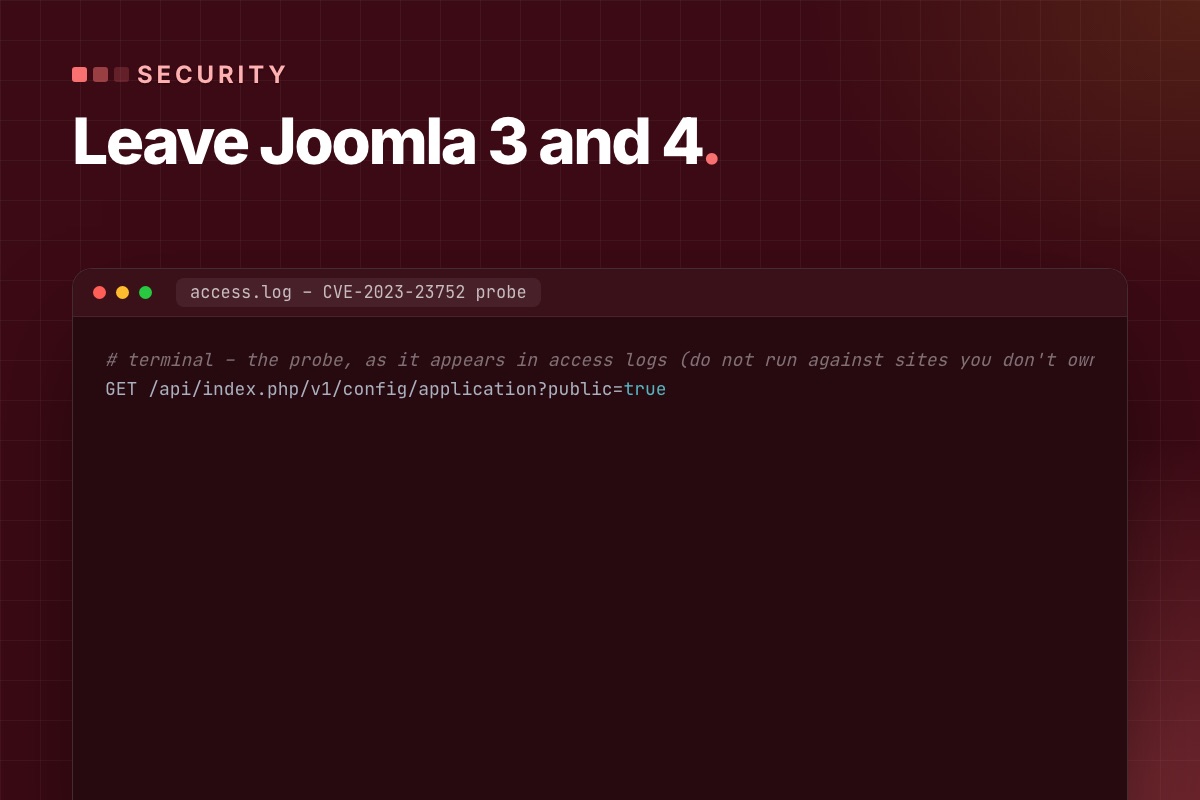
CVE-2023-23752 affected Joomla 4.0.0 to 4.2.7. One unauthenticated request to the Web Services API returned the site configuration, including the database user and password:
# terminal – the probe, as it appears in access logs (do not run against sites you don't own)
GET /api/index.php/v1/config/application?public=true
It was fixed in 4.2.8, within days, and automated scanners still request this URL on every Joomla site we look after, years later. The lesson isn't this specific bug. The scan for a published flaw starts within days, and it never stops. A site that got 4.2.8 the week it came out was fine. A site that stayed on 4.2.7 had its database password in the hands of anyone who asked.
Check your own log for it:
# terminal
grep -c "v1/config/application" /var/log/nginx/example.com.access.log
How to tell where a site stands
# terminal – Joomla version from the files (works even when the back end is broken)
grep -E "MAJOR_VERSION|MINOR_VERSION|PATCH_VERSION" libraries/src/Version.php          # Joomla 4, 5, 6
grep -E "RELEASE|DEV_LEVEL" libraries/cms/version/version.php libraries/src/Version.php 2>/dev/null   # Joomla 3

php -v # and the PHP version the web server uses: System → System Information| Site on | Risk today | Route |
|---|---|---|
| Joomla 3.x | high: no fixes since 2023, PHP ≤ 8.0 | 3.10 → 4.4 → 5.4 (→ 6), template rebuilt |
| Joomla 4.0–4.3 | high: known API flaw, no fixes | 4.4 → 5.4 (→ 6) |
| Joomla 4.4 | medium: end of life since Oct 2025 | 5.4 (→ 6) |
| Joomla 5.4 | low: security fixes until Oct 2027 | plan Joomla 6 |
Why Joomla 3 is the expensive step
Joomla 4 rewrote the core: namespaced classes, a new MVC, Bootstrap 5 and a new admin template. A Joomla 3 template can't be converted, it has to be rebuilt. Joomla 3 extensions need Joomla 4 versions, and many never got one. The database moves across with the official migration, and that's the easy part.
From Joomla 4.4 on, it gets much easier. 4.4 → 5.x and 5.4 → 6.x are mostly updates plus fixes for deprecated code, thanks to the backward-compatibility plugins Joomla ships for each major version. The step-by-step is in our Joomla 3/4 to 5.4 migration guide.
If you can't upgrade this month
Sometimes a budget or an abandoned extension blocks the upgrade. Until it happens, reduce what an attacker can reach:
- Joomla 4.0–4.2: update to 4.4.x now. It is a normal update in the back end, not a migration, and it closes the API flaw.
- Deny the API at the web server if nothing uses it (
location ^~ /api/ { deny all; }). - Password-protect
/administratorat the web server and enforce MFA (Joomla 4.2+). - Block PHP execution in
images/,media/andtmp/. - Remove every extension you don't use. Disabled isn't enough, the files are still reachable.
- Back up off-site, daily, and restore one backup once to make sure it works.
The details for each are in Joomla security against automated attacks. None of this replaces the upgrade. It buys the weeks you need to do it properly.
What you get on the other side
A site on Joomla 5.4 or 6 isn't just patched. It has a few things that make the next ten years cheaper: a template and code base that follow current Joomla APIs, so future updates are small; MFA and passkeys in core; a Scheduler for background jobs; automated core updates (Joomla 6); and PHP 8.3, which is noticeably faster than the PHP 7.4 most Joomla 3 sites run on.